Announcement

Collapse
No announcement yet.

Politicising again.

Collapse
X
 
  • Filter
  • Time
  • Show
Clear All
new posts

    Politicising again.

    Here we go, Politicising Classical music again.


    Renowned pianist Andr?s Schiff has announced he will not perform in the United States for the duration of Donald Trump’s presidency, condemning what he describes as an era of 'ugliness' and injustice. In an interview with The New York Times, Schiff, expressed particular distress over the administration’s immigration policies, drawing parallels to his own family’s history of deportation during the Holocaust.

    https://www.gramophone.co.uk/interna...tional%20Piano
    Last edited by Megan; 03-26-2025, 04:41 PM.
    ‘Roses do not bloom hurriedly; for beauty, like any masterpiece, takes time to blossom.’

    #2
    On the one hand, it has always struck me as silly for companies, actors, or musicians to potentially alienate what could be half their customers or audience by taking a side in a political debate that has nothing to do with their product or work. On the other hand, the performing arts are so dominated by liberal politics (at least here in the USA) that maybe this will actually raise his stock here.

    Comment


      #3
      Italian concert by Putin-linked Russian conductor called off after outcry

      Thousands, including Alexei Navalny’s widow, signed letter objecting to performance by Valery Gergiev, a close ally of Russian president

      https://www.theguardian.com/music/20...r-outcry-putin

      Comment


        #4
        When has music never been political?

        "My baton is my weapon", says Canadian conductor Keri-Lynn Wilson. She goes on to say that "The opening four notes [of Beethoven's 5th symphony] were famously used as a sign of resistance in occupied Europe during the second world war, and the BBC used it during blitzkrieg. It is about resilience. It reminds us that art is a political weapon."

        ‘No Russian words from my lips, no Russian music from my hand’: the Ukrainian Freedom Orchestra hit the UK

        https://www.theguardian.com/music/20...m-orchestra-uk

        Comment


          #5
          Come out to show them (Steve Reich)

          Now here's a prime example of politics (social issues) and music: Steve Reich's "Come Out".

          Come Out is a 1966 piece by American composer Steve Reich. Reich was asked to edit down tape footage into a form of collage for a benefit for the Harlem Six and Come Out was a byproduct of the collage's production. The Harlem Six were six black youths arrested for a murder of Margit Sugar, a Hungarian refugee, in Harlem in the weeks following the Little Fruit Stand Riot of 1964. Only one of the six was responsible while the lead witness is generally considered the actual perpetrator. Truman Nelson, a civil rights activist and New Yorker who had asked Reich to compose a sound collage that was separate from Come Out, gave him a collection of tapes with recorded voices to use as source material. Nelson agreed to give Reich creative freedom with the tapes that he presented him for the sound collage. Come Out was a loop of four seconds from the more than 70 hours of tapes Nelson presented to Reich.

          Reich eventually used the voice of Daniel Hamm, one of the boys involved in the riots but not responsible for the murder; he was nineteen at the time of the recording. At the beginning of the piece, he says, "I had to, like, open the bruise up, and let some of the bruise blood come out to show them" (alluding to how Hamm had punctured a bruise on his own body to convince police to allow him to receive medical aid).

          The full statement is heard three times. Next, Reich re-recorded the fragment "come out to show them" on two channels, which initially play in unison. They quickly slip out of sync to produce a phase shifting effect, characteristic of Reich's early works. Gradually, the discrepancy widens and becomes a reverberation and, later, almost a canon. The two voices then split into four, looped continuously, then eight, until the actual words are unintelligible. The listener is left with only the rhythmic and tonal patterns of the spoken words. Reich says in the liner notes of his album Early Works of using recorded speech as source material that "by not altering its pitch or timbre, one keeps the original emotional power that speech has while intensifying its melody and meaning through repetition and rhythm." The piece is a prime example of process music.

          Source: Wikidepia

          Comment


            #6
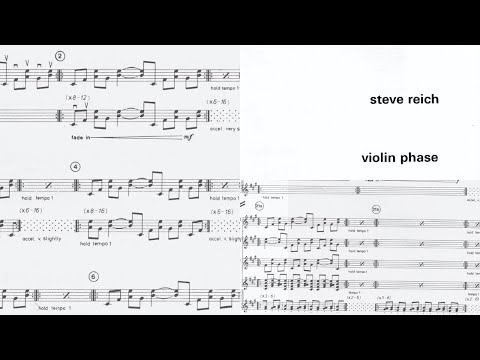
            Going beyond the political-musical, the recorded looping and phasing techniques led Reich to develop these into one of his most well-known pieces, Violin Phase.

            Comment

            Working...
            X